
Why AEO is More Important than SEO in 2026
Introduction
You wake up one day and find 150+ inbound leads in your inbox.
Your heart races. You wonder why and how this happened overnight.
You log into your website analytics. There it is. Your SEO efforts finally paid off. Your website now ranks #3 on Google for your most valuable keyword.
You lean back in your chair and smile. Guaranteed visitors. Guaranteed leads. You know your pipeline won’t be dry for at least the next few months. Maybe longer.
This could’ve been your reality 8 months ago. Maybe even a year ago.
But today? The game has changed completely.
You still rank #3 on Google. That hasn’t changed. But here’s what has: your traffic dropped 40% in the last six months.
How is this even possible?
The answer sits right there on Google’s search page. AI Overviews now answer your target queries directly. Users get what they need without ever clicking your link.
The numbers tell a brutal story. ChatGPT hit 800 million weekly users by October 2025. Google’s AI Overviews appear in 30% of all searches. They dominate nearly three-quarters of problem-solving queries.
Your potential customers are finding answers. Just not on your website.
The buyer journey shifted under your feet. Discovery happens inside AI answers now. Before users reach ANY website. Before they click ANY link.
Welcome to 2026. Ranking for the answer isn’t enough anymore. You need to BE the answer.
What is AEO? (And Why Should You Care?)
In 2026, people don’t just “Google it” anymore. They ask their AI assistants for answers.
This shift created a new challenge for businesses: Answer Engine Optimization (AEO).
If you want your brand to be the one AI recommends, you need to understand why AEO now matters more than traditional SEO.
Think of AEO as the “straight to the point” version of SEO.
SEO (Search Engine Optimization) ranks a link on a results page. Its goal? Get someone to click and visit your website.
AEO (Answer Engine Optimization) makes you the answer itself. Its goal? Get AI tools like ChatGPT, Perplexity, or Google’s AI Overviews to quote your brand as the solution.
Here’s the difference at a glance:
|
Feature |
Traditional SEO |
Modern AEO |
|
Main Goal |
Clicks to your website |
Citations in AI answers |
|
Content Type |
Long blogs (1,500+ words) |
Direct answers (40–60 words) |
|
Search Style |
Short keywords (“best shoes”) |
Full questions (“what shoes fit flat feet?”) |
|
Success Metric |
Traffic and Rankings |
Mention share and Brand trust |
OG Image Alt Text: “Diagram showing the difference between SEO clicks and AEO citations in 2026.”
Both matter. But in 2026, getting cited matters MORE.
The Big Problem: Zero-Click Searches Are Taking Over
Here’s the uncomfortable truth that all businesses are going to face in 2026. The content game is changing for good.
Over 60% of searches end without a single click. The user never visits ANY website.
Why?
Because the AI assistant gives them the answer right on the screen.
If you only focus on SEO, you’re fighting for the 40% of people who still click links.
If you focus on AEO, your brand stays visible even when nobody clicks. Because the AI says: “According to [ Brand Name], the best solution is…”
The numbers back this up. AI Overviews satisfy user questions right on Google’s results page. When AI Overviews appear, zero-click rates reach 83%. That means 8 out of 10 people get their answer and leave.
Traditional rankings mean nothing if AI ignores you.
Your brand must exist within the AI summary box. Or you become invisible.
Understanding the 2026 Search Landscape
Three strategies now control online visibility:
SEO (Search Engine Optimization)
SEO makes sure search engines can find your website. Helps you rank in search results. Gets your pages indexed.
AEO (Answer Engine Optimization)
AEO structures content so AI can extract and cite it. Focuses on being mentioned in AI answers. Optimizes for zero-click visibility.
GEO (Generative Engine Optimization)
GEO builds your reputation inside AI training data. Makes your brand appear in AI recommendations. Creates trust with AI systems.
Think of it this way:
- SEO = Getting invited to the party
- AEO = Getting introduced to everyone there
- GEO = Being remembered as the star guest
AEO bridges the gap between ranking and being chosen.
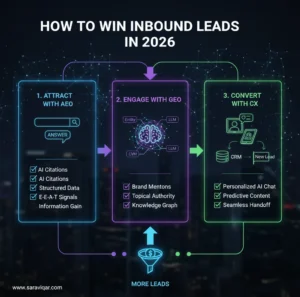
How AEO Powers Your Brand Authority
When AI cites your brand, users naturally start trusting your brand more.
AI assistants filter information for credibility. When ChatGPT recommends three project management tools, users form opinions about those brands immediately.
Often without visiting the websites.
Discovery happens inside AI conversations now. Citations in Perplexity and ChatGPT replace traditional backlinks.
Authority is measured by citation share. Not website traffic.
How to Improve Your Website’s AEO Ranking
You don’t need to be a tech genius to win at AEO. Follow these three steps to get started:
A. Use the “Answer First” Formula
AI crawlers look for quick facts.
Start your articles with a 40–60 word summary that directly answers the main question. Put the details and long-form content below that summary.
Bad Example: “There are many factors to consider when choosing the right software for your business. In this comprehensive guide, we’ll explore various options…”
Good Example: “What’s the best CRM for small teams? HubSpot CRM works best for teams under 10 people because it’s free, includes email tracking, and integrates with Gmail. Here’s why…”
Notice the difference, the good example answers immediately, and then explains it.
- Focus on “Information Gain”
AI models ignore content that repeats what everyone else already said.
To be cited, you must provide unique data:
- Share your own original surveys – Poll your customers and publish results
- Talk about your personal first-hand experience – “I tested 15 email tools over 3 months…”
- Provide a hidden tip competitors haven’t mentioned – Insider knowledge from your industry
Generic content gets buried. Unique content gets cited.
C. Build “Non-Owned” Authority
AI doesn’t just trust your website. It looks at what others say about you.
Mentions on Reddit, Quora, and high-quality news sites act as a “green light” for AI to trust your brand.
This is crucial. When ChatGPT sees multiple independent sources mentioning your brand positively, it feels safe recommending you.
Get featured in industry publications. Answer questions on Reddit authentically. Be helpful on Quora. Build reputation in places you don’t control.
Your Technical AI Checklist
To make your site “machine-readable” for AI crawlers, ensure you have these four things:
- FAQ Schema – Use structured data (code that tells Google which part is a question and which is the answer)
- The llms.txt File – A new standard file in 2026 that helps AI agents understand your content faster
- Lightning Speed – AI assistants prefer sites that load instantly. Focus on Interaction to Next Paint (INP under 200ms)
- Simple Hierarchy – Keep your site easy to navigate. AI agents hate messy, deep menus
Additional Technical Setup
- Add Organization schema with complete entity information
- Create XML sitemap specifically for AI crawlers
- Use semantic HTML5 elements (article, section, header)
- Implement breadcrumb schema for context
- Add author and publisher schema to all content
- Ensure mobile viewport is properly configured
- Prepare images for multimodal AI visual search
- Test content extraction with AI tools
Measuring Success in the AI Era
Traditional metrics don’t tell the complete story anymore.
Track These New Metrics
Citation Frequency – How often do AI platforms mention your brand?
Brand Sentiment – Are you recommended positively or just mentioned?
AI Overview Impressions – 400+ million people use OpenAI products each week. How often do they see your brand?
Referral Traffic from AI – Some AI platforms include source links.
Share of Voice – What percentage of relevant queries include your brand versus competitors?
Which Industries Need AEO Most?
Different businesses need different AEO approaches.
B2B Companies
Enterprise buyers research solutions using AI before contacting vendors. Your brand must appear in these early conversations.
Legal and Healthcare
Google’s E-E-A-T framework matters especially for Your Money, Your Life (YMYL) sites like finance or health. AI systems heavily vet sources in these sectors.
E-Commerce Stores
When users ask “best wireless headphones under $100,” your products need to appear in AI lists.
Local Services
Voice commerce will reach $80 billion by 2026. “Near me” searches get answered by voice assistants first.
SaaS Brands
Tutorial content and documentation must be structured for AI extraction.
2026 Ranking Strategy Summary
The hierarchy is clear.
SEO gets you indexed. Without it, AI can’t find your content.
AEO gets you cited. With it, AI mentions your brand in answers.
Both are essential. One without the other leaves opportunities on the table.
Focus on clarity and unique data. Content that satisfies user intent is the number one factor Google considers.
Companies that optimize for answer engines now will own their categories tomorrow.
Frequently Asked Questions
1. What are the main differences between AEO and SEO strategies?
SEO focuses on rankings and clicks. You optimize for keywords. You build backlinks for authority. You target specific search positions.
AEO focuses on citations and zero-click visibility. You optimize for direct answers. You structure content for extraction. You target AI mentions.
Both work together. SEO provides the foundation. AEO ensures AI systems actually cite your content.
2. How can I improve my website’s AEO ranking instead of focusing on SEO?
Don’t stop doing SEO. Add AEO on top of it.
Start by restructuring existing content into Q&A formats. Add comprehensive schema markup (FAQ, HowTo, Organization). Create unique data AI can’t find elsewhere.
Optimize for conversational queries. Build topical authority by covering subjects deeply.
The best strategy? Improve SEO while adding AEO optimization.
3. Is investing in AEO more cost-effective than traditional SEO for online retailers?
AEO complements SEO. It doesn’t replace it.
For retailers, product schema delivers immediate AEO benefits. You’re already adding product information. Just structure it properly.
Early AEO investment captures visibility before competitors adapt. Companies that started optimizing for AI in early 2024 now capture significantly more traffic than those who waited.
Cost-effectiveness comes from future-proofing your strategy.
4. Where can I find tools to analyze AEO versus SEO performance?
Several tools now track AI visibility. Bear AI starts at $200/month and monitors citations across ChatGPT, Perplexity, Google AI Overviews, and Claude.
GrackerAI offers free plans with basic tracking. Paid plans start around $2,000/month for enterprise features.
Semrush tracks AI Overview appearances. AlsoAsked.com reveals question clusters. Search Console shows impression-to-click ratios.
Most SEO tools are adding AEO tracking features.
5. Can I combine AEO and SEO strategies to maximize my site’s visibility?
Yes. They’re complementary strategies.
Traditional SEO best practices support AEO success:
- Quality content helps both
- Proper technical implementation matters for both
- Authority building supports both
The difference? Add structured data. Optimize for conversational queries. Create citation-worthy content.
Integrated strategies perform best. 80% of consumers rely on AI summaries for nearly half their searches. You need visibility in both traditional search AND AI answers.
6. Will AEO replace SEO completely?
No. AEO builds on SEO foundations.
AI systems rely on search indexes to find sources. Strong SEO puts your content where AI can discover it. AEO ensures AI cites that content.
Think of SEO as the house foundation. AEO is the paint that makes it stand out.
7. How long does it take to see AEO results?
Faster than traditional SEO in some cases.
Schema markup changes can appear in AI systems within weeks. Content restructuring shows results in 1-3 months. Building topical authority takes 6-12 months.
AI platforms update their sources more frequently than traditional search engines update rankings.
8. Do I need different content for AEO versus SEO?
No. Optimize the same content for both.
The best approach: Write comprehensive content that ranks well (SEO). Then add Q&A sections, schema markup, and structured data (AEO).
Your existing content library is your AEO starting point. Restructure it rather than recreating it.
9. What’s the biggest AEO mistake businesses make?
Treating it like traditional SEO.
The biggest mistakes:
- Only optimizing for keywords instead of questions
- Ignoring schema markup entirely
- Creating long-form content without direct answers
- Not tracking AI citations
- Waiting for competitors to move first
Start now. Even basic AEO implementation helps.
10. How do I know if my content is AEO-ready?
Ask these questions:
- Does your content answer questions directly in the first paragraph?
- Have you implemented FAQ or HowTo schema?
- Can someone extract a useful answer from your content in 40-60 words?
- Does your content include unique data or perspectives?
- Is your site technically optimized for AI crawlers?
If you answered “no” to any of these, you have AEO work to do.
And if you need help with AEO/SEO for your website, don’t hesitate to reachout https://saraviqar.com/contact/